.png)
What does a car engine, a hospital emergency room and the launch of GPT-5 have in common? Sounds like the start of a joke, but it isn't. Let me tell you why I'm using these metaphors to introduce OpenAI's new model.
In case you missed it, GPT-5 has been one of the (or *the*) blockbusters of the summer in the AI industry. In this article, I want to help you understand the technical novelties of this model and give you the keys to squeeze every drop out of it this new season.
GPT-5 is the new, more powerful engine
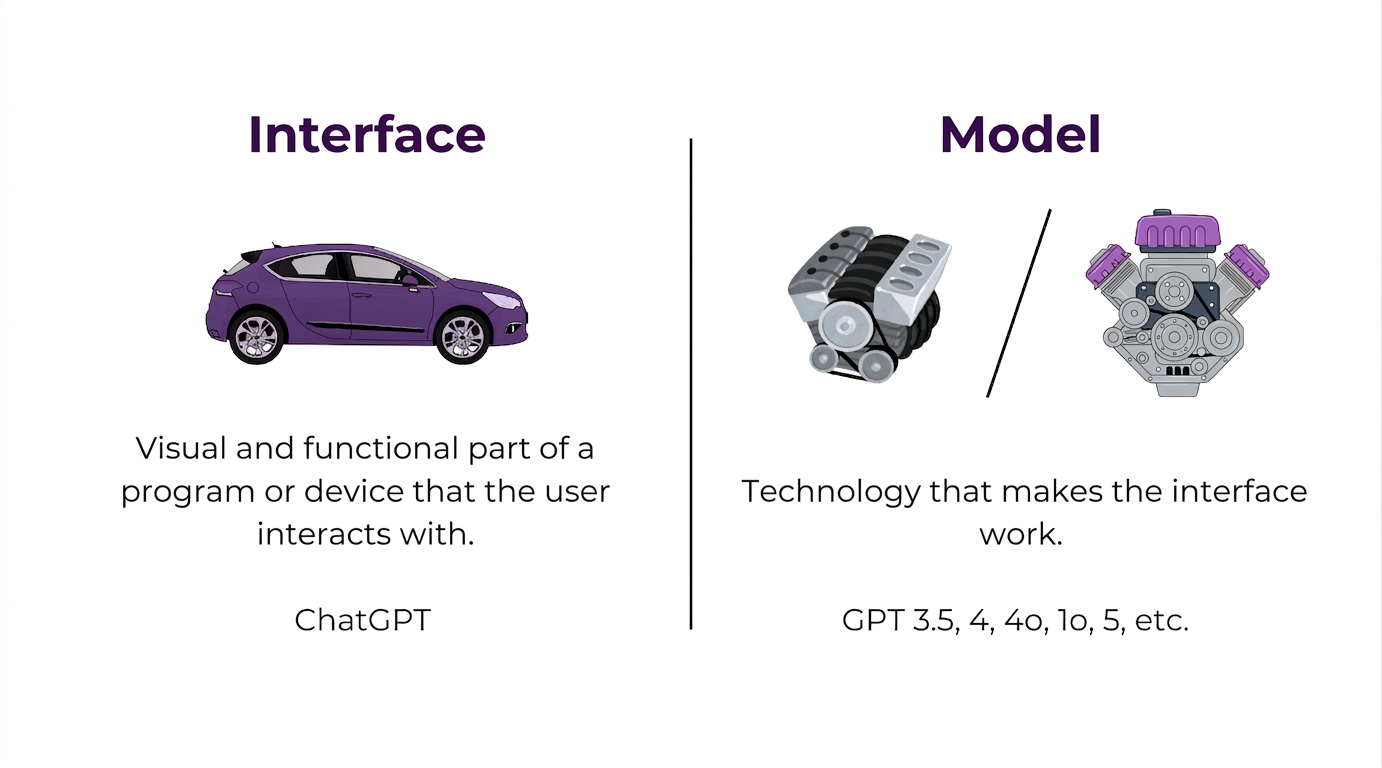
To understand the difference between a model and an interface, think of a car. On the one hand, you have the body, the seats, the steering wheel, the gear shift… all those visual and functional parts you, the driver, interact with to make the car do what you want. But there's something very important under the hood — without which the car won't move an inch, no matter how hard you press the gas pedal: the engine.
The same goes for AI tools: they're made up of an interface, the visual and functional layer the user interacts with, and a model, the engine that makes the tool work. ChatGPT is the interface and, historically, it has had many models: GPT-3.5, 4, 4o, o1, etc.
Just as there are gasoline, electric and hybrid engines, there are also different models powering AI tools. Some are faster, some are more powerful, some consume less… In this case, GPT-5 is that new engine: more powerful, more versatile and with better performance than its predecessors.
GPT-5 unifies the models
As I was saying, ChatGPT has had many engines throughout its history. Until now, with GPT-4o, o3, o4 mini and others, you had multiple specialized models to use at any given moment. But the choice was up to the user. For those who didn't master the technical side, it could be a real headache. GPT-5 now incorporates "a real-time router that quickly decides which model to use based on the type of conversation," according to OpenAI's own page.
Let's go back to the hospital emergency room metaphor. Before, when we had to choose the model, it was like walking into the ER with chest pain and having to guess whether to ask for a cardiologist, a pulmonologist or a general practitioner directly. Obviously, most patients weren't qualified to do that.
When we say GPT-5 has a "real-time router," it means they've added a triage nurse at the ER door so that, when you arrive, your case gets filtered and you're directed to the specialist you need.
The same happens with this launch: GPT-5 isn't a single model, but a set of submodels coordinated with each other (Auto, Instant, Thinking Mini and Thinking). When you send a prompt, the router automatically decides which submodel is best prepared to handle the task and returns the most fitting response. OpenAI explains it here and in the technical document Inside GPT-5 for Work.
Frequently asked questions about GPT-5
I don't like GPT-5 — can I get the previous model back?
Yes, and don't worry, you're not the only one. In the paid version, just go to Settings (bottom left, click on the photo) > General > Show legacy models. If you turn on this little tab, you'll also be able to see previous models in your conversations and keep choosing the one you prefer.
Can I choose which model to use in custom GPTs?
Yes — and in fact, this is one of the big new features. Now, when you open a GPT, just click on its name (top left corner) and select the model you want to use.
Can I access GPT-5 with a free account?
Yes. OpenAI has confirmed that GPT-5 is also available for users with free accounts.
What's ChatGPT's IQ?
ChatGPT is currently estimated to have an IQ of 155, compared to the 160 attributed to Einstein, according to this analysis. How about that!
A more powerful engine, but still being broken in
It's clear GPT-5 opens a new chapter in ChatGPT's history, but it's also true that its launch came with criticism from users. Some say this new model is cold and distant, unlike the 4o we'd grown used to.
Personally, I wouldn't worry: in the AI world, new things hit the market when they're still a bit raw. Why? To get immediate, massive feedback from users and use it to perfect the product. I'm convinced that's exactly what OpenAI has in mind: keep refining GPT-5 until we're all head-over-heels for their new toy.