


.png)
Have you heard of prompts but don't know what they are? Do you want to tap into ChatGPT's potential but can't get it to give you good answers? Would you like to know how you should interact with AI models?
In this article we'll tackle all those questions so you can master the art of prompting and start squeezing the most out of AI. Let's go!
What prompts are and how to write them
Put simply, a prompt is the instruction we give an AI model so it returns the response we want. If you've tried ChatGPT, the prompt is the message you type in the bar at the bottom, where you ask for what you want:
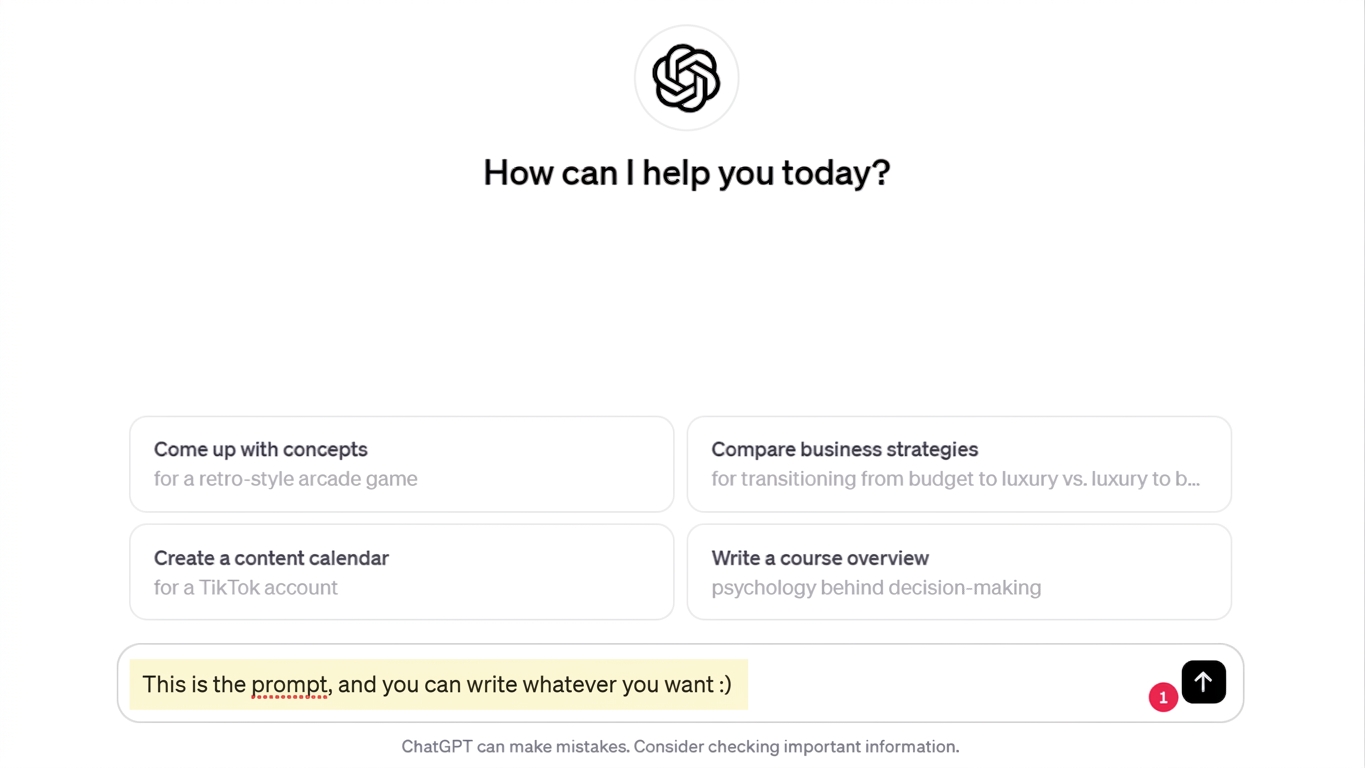
The better that input is, the better the output you get. In other words: the quality of your prompts directly impacts the quality of the answers AI models give you back.
Since ChatGPT launched in November 2022, millions of users have experimented at scale with different ways of interacting with the chatbot to figure out which practices work best. As a result, OpenAI, the company that built the model, has published its own guide.
The discipline that creates complex prompts for specific tasks, consistently producing optimized responses, is called "prompt engineering."
And although the name suggests it's a very technical specialty, even out of reach for the average user, the reality is different: today's AI models are designed for us to interact with them in natural language. In other words: we have to talk to them the way we'd talk to a person.

I like to think of ChatGPT as a new employee who's just walked into the office, full of enthusiasm and knowledge, but still a bit lost about what they're supposed to do. If you give them a very superficial instruction, no matter how hard they try, the result will never live up to your expectations, because they'll lack the context to understand what you need.
So it's essential we learn to give good instructions and, therefore, to write good prompts for AI. And to do that, you only need to follow the ROCE method.
Prompts can help. The AI at welov.io does it for you. Get your qualitative social media analysis in seconds. Request your free 7-day demo now.
What a good prompt should include: the ROCE method
The internet is full of tips for writing good prompts, and although they're a really useful resource, it can be a bit overwhelming to face so much information at once. So I suggest you use the acronym ROCE, a formula I've created to help you remember, in an orderly way, all the elements a good prompt should include (it's a Spanish acronym — and a deliberate pun, since roce means "friction" or "contact" in Spanish):
- R — Rol (Role)
- O — Orden y objetivo (Order and Objective)
- C — Contexto (Context)
- E — Estilo (Style)
Let's break down each point in more depth.
Role
This is about telling the model the function you want it to play. The goal is to give the AI model enough information so that it acts like a true expert in the task at hand, ensuring it provides a rigorous response that reflects that expertise.
Some popular formulations are telling the tool it's a subject-matter expert with a complete university education and ten years of relevant professional experience (the number of years isn't decisive — what matters is signaling that it should act like someone who knows what they're doing).
Bonus tip: if you want help with your day-to-day tasks, simply describe your own role and add some quality that would make you even better. In my case, for example, I could say I'm an expert copywriter, with a complete university degree in Linguistics and Journalism (which is true), and ten years of experience as a copywriter (which isn't true yet, simply because I'm too young for that).
Let's see an example:
You are an expert in digital writing and copywriting, with a complete university degree in linguistics and 10 years of professional experience in travel writing.
A heads-up: the role works wonders in some models, like ChatGPT in both its free and paid versions, but can confuse others, like Microsoft's Copilot. When you try a new model, test whether the result improves or not when you specify the role.
Order and Objective
The letter O does double duty in the ROCE acronym, since it covers both order and objective together. Be specific and direct about what you want to achieve: instead of saying "Could you help me write a blog post about Basque cuisine?", it's much better to ask ChatGPT to write a "500-word article about the Basque pintxo 'gilda,' with subsections on its ingredients, its origin and the best bars to try it, with H2s and H3s, bold text and a colloquial tone."
It's also a good idea to explain the function of the response — that is, what it will be used for. In the example above, you could add a tag explaining it'll be published on a food-travel blog.
The order-and-objective component would look like this:
Write a 500-word article about the Basque pintxo 'gilda,' with subsections on its ingredients, its origin and the best bars to try it, with H2s and H3s, bold text and a colloquial tone, for a food-travel blog.
Context
The more information the model has, the better it can tailor its response to your specific needs. So it's essential to be thorough when explaining context. It can help to keep the journalist's 5 Ws in mind: what, who, where, when and why. If you answer those five questions, you'll make sure the AI model fully understands your requirements.
Continuing with the previous examples, here's a good context:
This blog specializes in publishing engaging content for couples between 30 and 50, with foodie experiences that connect with local cuisine and offer a unique, exclusive viewpoint on destinations. The article will be published in May, with the goal of attracting tourists planning to travel in summer, since that's the most popular time of year to visit the Basque Country.
Style
Finally, the last section of the ROCE method covers style guidelines. Every company, institution and writer has their own way of writing, which can be more formal or informal, serious or comedic, complex or accessible, with long or short sentences and paragraphs, with or without bold text, etc.
The more clearly you've identified your style, the better. Pass on as many guidelines as you can to the model, so it learns and imitates your expressions and turns of phrase. For example:
The text should have H2 and H3 headings, paragraphs of up to 5 lines, a mix of long and short sentences, bullet-point lists, and very clear, accessible language for a general audience.
Use AI to analyze social media like an expert. Generate qualitative insights effortlessly. Request your free 7-day demo now at Welov.io
The 4 elements of a complete ChatGPT prompt
There you have it! Following the ROCE method, you'll always remember that a good prompt for an AI model should always include the role, the order and objective, the context and the style.
Since I know we learn better through examples, here's the full prompt with the elements we've worked through over the article:
You are an expert in digital writing and copywriting, with a complete university degree in linguistics and 10 years of professional experience in travel writing.
Write a 500-word article about the Basque pintxo 'gilda,' with subsections on its ingredients, its origin and the best bars to try it, with H2s and H3s, bold text and a colloquial tone, for a food-travel blog.
This blog specializes in publishing engaging content for couples between 30 and 50, with foodie experiences that connect with local cuisine and offer a unique, exclusive viewpoint on destinations. The article will be published in May, with the goal of attracting tourists planning to travel in summer, since that's the most popular time of year to visit the Basque Country.
The text should have H2 and H3 headings, paragraphs of up to 5 lines, a mix of long and short sentences, bullet-point lists, and very clear, accessible language for a general audience.
Want to see what this prompt produces? It's as simple as opening a session in ChatGPT (or your favorite text-generation AI) and pasting in the full instruction.
Remember that you'll always need to include some edits to perfect the style and you'll need to fact-check all the information. Likewise, if the result doesn't convince you, you can keep the conversation going with extra requests, like asking it to develop some sections in more depth or to adopt a more informal tone.
In this case, I can assure you, as a born-and-raised donostiarra (someone from San Sebastián), that the bars it mentions in the result do serve some spectacular gildas… And that's it! Now you're ready to write your own prompts and start putting AI's capabilities to work for you. Go for it!
By the way, if you want to keep learning more about artificial intelligence applied to marketing and communication, follow me on my LinkedIn profile and subscribe to my newsletter.
Use AI to analyze, predict, and improve your content. Say goodbye to manual analysis and get insights in seconds. Try welov.io free for 7 days



.png)
